Here is a strange fact about a sport judged entirely on bodies: nobody
measures them.
No bodybuilding federation on earth publishes the height of its athletes.
Not the IFBB Pro League, not the NPC, not NABBA or the WFF. Weight
sometimes exists, for the one division that still runs weigh-ins. Height —
the most basic anthropometric fact there is, printed on every basketball
roster and every Olympic start list — simply is not recorded, or if it is,
it never leaves the building. When you read that a Ms. Olympia competitor
is 5’6″, that number traces back, in every case we checked, to a magazine
article, a sponsor bio, or the athlete’s own website. Wikipedia’s infobox
heights are those same numbers wearing a tie.
We documented that gap federation by federation in our reference dossier
on anthropometric data, and
we run a site whose whole premise is that the structured record for this
sport has to be built from the outside. So when a reader — Jon, an analyst
by temperament, who had been pushing us on exactly this — sent a link to a
contest gallery and asked, more or less, “the numbers going around don’t
match my eyes; can’t you check?”, we tried to check.
This is the story of what worked, what failed, and the two numbers we are
now willing to publish. The failures are the point. Anyone can run a pose
model over a photo and print a number; the work is everything you do to
earn the right to believe it.
The idea
Stage photography has a property that fan estimates don’t: geometry.
When two athletes stand side by side in a lineup, the camera doesn’t care
about anyone’s listed height. If you know one athlete’s real height, the
other’s follows from the pixels — provided you can find the top of a head
and the ground under a heel, and provided both athletes are actually
standing upright, barefoot, at the same distance from the lens. (The
divisions we measured compete barefoot, so footwear never enters the
comparison.)
Those two “provided”s took a month.
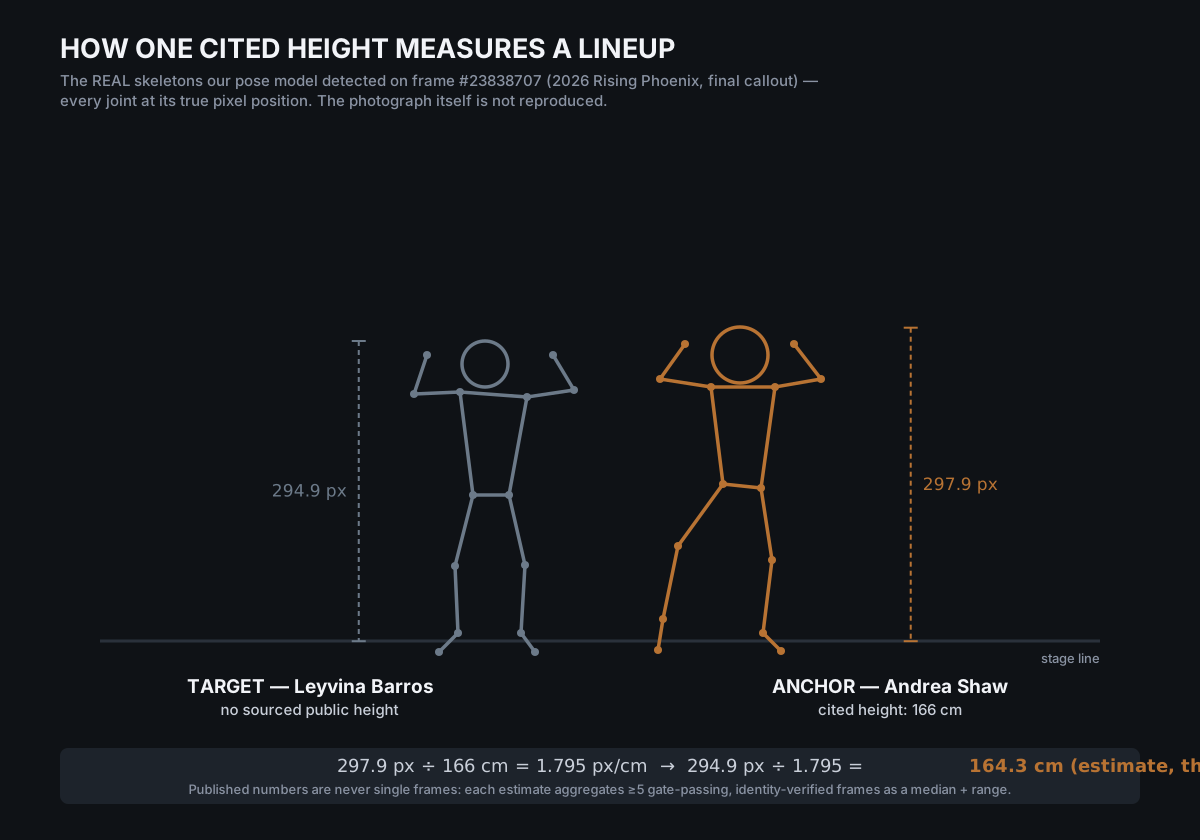 Andrea Shaw, cited at 166 cm, measures 297.9 pixels; dividing gives 1.795 pixels per centimeter, which converts the target's 294.9 pixels into an estimate of 164.3 cm for that frame." loading="lazy" style="width:100%;height:auto;">
The raw ingredients are unglamorous: publicly posted contest galleries
(analyzed transiently — we store photo IDs and derived numbers, never the
images, which belong to their photographers), a free open-source pose
model that finds skeletal landmarks, and a handful of athletes whose
heights are citable enough to serve as rulers. We call those anchors, and
the first honest finding of the project was how thin that tier is: our
anchor table has eleven names, and even those trace to sources like a
DigitalMuscle profile, a local TV segment, and an athlete’s own 2014
“About” page. For one anchor the best available citation is a fan site,
and we flag it as such in every receipt that uses her.
None of this is our invention. What we do has a name in forensic science —
direct-scaling analytical photogrammetry: deriving a measurement from an
image using a known reference inside the scene. It is how investigators
put a height on a suspect caught by a bank camera, the academic
foundations go back to single-view metrology (Criminisi, Reid &
Zisserman), the field has
published best-practice standards,
and our validate-on-known-people approach follows the template forensic
statisticians use for exactly this problem (Edelman & Alberink
2010). Published forensic work
reports errors around two centimeters — with calibrated cameras or
reconstructed scenes, on original footage. We have neither: web JPEGs and
no camera. So instead of calibrating we assume the athletes in a lineup
stand at the same depth, test that assumption on every frame (when two
known heights share a frame, their pixel scales must agree or the frame
is discarded), and measure our error empirically instead of deriving it.
That our number lands in the same range as the calibrated work is
encouraging; it is not the same thing, and we won’t pretend it is.
The failures, in order of appearance
The phantom. In an early run the model hallucinated a skeleton that
wasn’t a person, and the pipeline calmly used it as the scale reference
for the whole frame. Everything downstream was garbage. Fix: anatomical
plausibility checks, a visibility floor, and a size filter before anything
becomes an anchor.
The poses. Bodybuilding is a sport of deliberate distortion — that’s
the art. A side chest bends the knee; a back pose hides the face; a
transition catches half a squat. Measured naively, the same athlete
“changed height” by several centimeters between poses. Fix: gates. Bent
knees, profile heads, uneven feet, twisted torsos — any of them and the
frame is refused. On wide stage shots the pipeline now rejects most
frames, and that is by design. A tool like this earns trust by saying
“no reading” far more often than it says a number.
The lucky impostors. Our strongest automated check is the residual:
with two known-height athletes in frame, their pixel scales must agree,
or the frame is thrown out. At one show, a later callout with four
different athletes slipped through it — the two women standing in the
expected positions happened to have a pixel ratio within tolerance of the
two we thought were there. At another, the same four athletes returned
mid-show in a different left-to-right order and the compensating errors
cancelled. Both escapes were caught the same way: a human looking at the
overlay images. The rule that came out of it is now absolute — no frame’s
numbers count until a person has verified who is standing where.
The catch we didn’t make. The best failure in the notebook wasn’t
caught by the pipeline or by us at the desk. The site’s owner glanced at a
quality-control montage and recognized, instantly, that the athlete our
run had labeled with a guessed name was someone else — an athlete he knows
on sight. Chasing that thread exposed a genuine hole: we had been
verifying the anchors’ identities frame by frame, but naming the
targets from roster logic. One athlete ended up with two estimates,
from two shows, twenty centimeters apart — which is not a measurement,
it’s an alarm. Every number for her was withdrawn, and the protocol
gained three rules: targets get the same per-frame identity verification
as anchors; athletes standing at the end of a lineup (where our depth
check can’t protect them) are never published from a single show; and any
athlete whose cross-show estimates disagree by more than five centimeters
has all her values pulled pending investigation. Convergence is the
publication bar. Field knowledge beat the algorithm, and the method is
better for it.
The number that matters
The test that makes or breaks all of this is called leave-one-out.
Take a frame with two or more known-height athletes. Pretend you only
know one. Estimate the others. Compare to their listed heights. Repeat
across every accepted frame of every show you can find.
We ran it across nine shows, four venues, and ten years of galleries —
Rising Phoenix editions from 2016 to 2026, plus three Ms. Olympias —
116 cross-checks on identity-verified, gate-passing frames:
| Systematic bias | +0.03 cm (none) |
| Typical error (MAE) | 1.98 cm |
| Median signed error | 0.00 cm |
| Worst single frame | 4.65 cm |
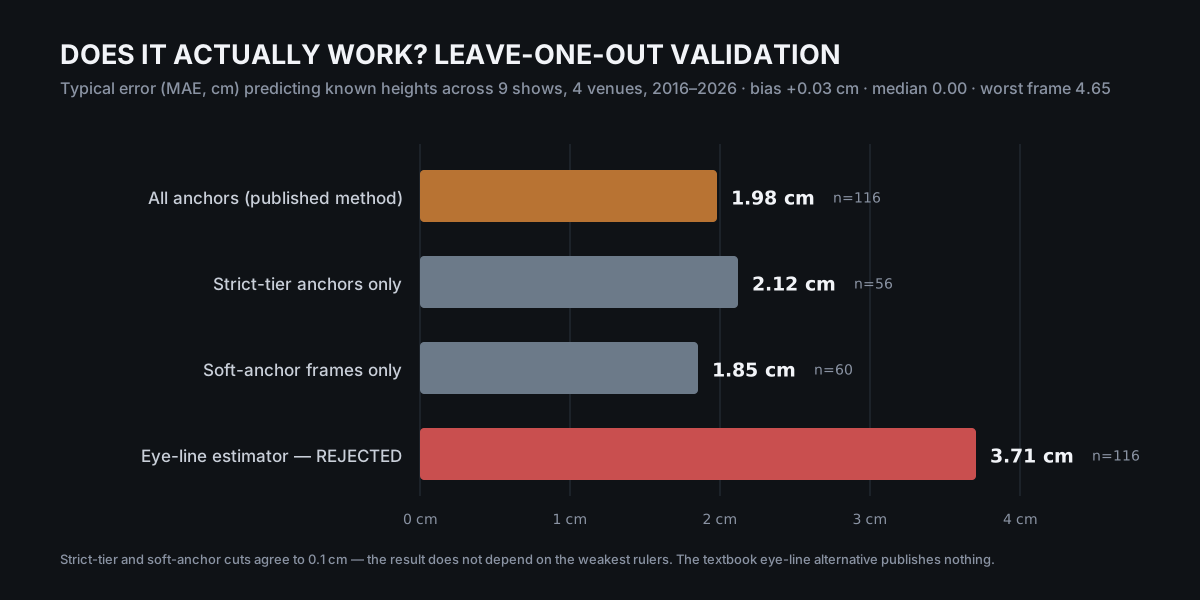
Two sanity cuts matter as much as the headline. Restricting to only the
strongest-sourced anchors barely moves the result (2.12 vs 1.85 cm), so
the method doesn’t secretly depend on its weakest rulers. And the
alternative estimator we tried — projecting from the eye line using
textbook anthropometric ratios — was nearly twice as bad and failed
completely at one venue, so it publishes nothing.
Almost 2 cm of typical error on 900-pixel gallery JPEGs, using free
models on a rented CPU, is better than we expected. It is also the reason
every published estimate aggregates at least five accepted frames and
states a range, never a lone number: single frames have tails.
One caveat we insist on stating ourselves before anyone states it for us:
leave-one-out measures agreement with the cited canon, not with a tape
measure. If every anchor’s listed height were inflated by the same two
centimeters — and self-reported heights do drift upward — this test could
not see it, because each anchor is judged by the others. Our numbers are
therefore anchored to the best public record, not to the ground; the day
any of these athletes stands against a measuring rod, that single
measurement will outweigh our whole anchor table, and we will use it.
There was a bonus we didn’t plan. Run the audit in reverse — treat each
anchor as the unknown — and the photo record starts commenting on the
public canon itself. Five of our six main anchors agree with their listed
heights within about a centimeter. For one, our accepted frames are not
compatible with the listed number, on a small sample — so rather than
draw conclusions about the number, we stopped using her as a ruler until
more frames exist. The method audits its own inputs; that is the point.
What we’re publishing, and what we’re not
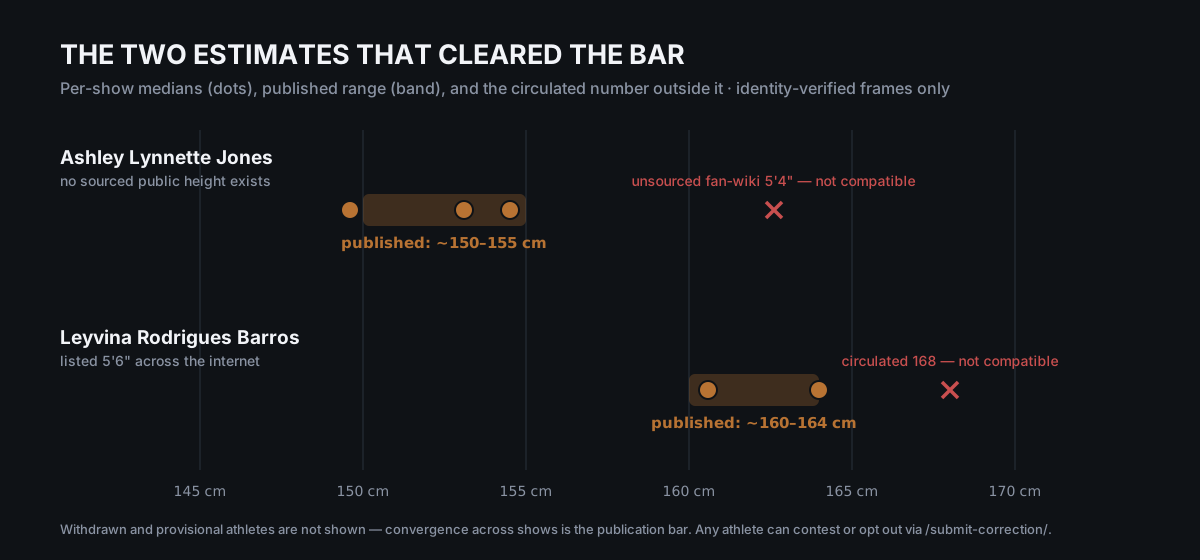
Two estimates cleared the bar.
Ashley Lynnette Jones — silver medalist at the 2025 Ms. Olympia,
top-four at the 2024 Ms. Olympia, podium at the 2024 Rising Phoenix — has
no sourced height anywhere — not Wikipedia, not a sponsor bio, nothing
that says where its number came from. Three independent
shows, three different anchor sets, three different positions in the
lineup, and the estimates converge: about 150–155 cm. An unsourced
figure that circulates on fan wikis (5’4″) is not compatible with our
accepted frames, within our stated uncertainty. To our
knowledge no one has published a sourced figure for her before, which
makes this the project’s first genuinely falsifiable prediction: if a
promoter ever stands her against a measuring rod, we find out publicly
whether this method is what we claim.
Leyvina Rodrigues Barros — bronze at that same 2025 Olympia — is
listed across the internet at 5’6″ / 168 cm. Two independent shows put
her at about 160–164 cm, and in every frame we accepted, her head
stands below that of an athlete whose 166 cm is among the best-sourced
numbers in the sport. The circulated 168 is not compatible with our
accepted frames, within our stated uncertainty and even after allowing
for the anchor’s own ±1 cm ambiguity. This
was, fittingly, the first athlete our reader asked about.
And the not-publishing list, which we consider the more important one:
one athlete’s numbers are withdrawn entirely (the twenty-centimeter alarm
above); another’s single-show estimate sits in a drawer until a second
show confirms or kills it; every ratio you might hope for (the V-taper
question) proved pose-sensitive and is not claimed; and nothing about
muscle size is measured here at all — a pose model reads joint centers,
not silhouettes, and we won’t pretend otherwise.
Estimates are labeled as estimates, carry their frame-ID receipts and
this methodology, and any athlete who disputes a number — or simply
doesn’t want one — can contest or opt out. The
record improves either way.
Why this exists
We didn’t build this to catch anyone out. We built it because the
alternative is worse: a sport whose entire visual argument is the body,
running on numbers that nobody measured, copied wiki to wiki until they
harden into fact. The federations could end this tomorrow with a
measuring station at check-in — the natural federations already ISAK-tape
athletes in research settings, and every NBA draftee’s wingspan is public
to the millimeter. Until then, the photo record is the closest thing this
sport has to an instrument, and it turns out to be a decent one: unbiased
to within a rounding error, honest about its precision, and — unlike a
circulated number — attached to receipts you can check.
Method, gates, error tables, and the full anchor-source list live on our
methodology pages. Contest photography referenced in
this analysis © J.M. Manion / NPC News Online; images were analyzed, not
reproduced. This article reports estimates derived from public
photographs and cited public statements; it makes no claim of officially
measured fact.